HVAC Sizing and Manual J for Arcadia Homes
The gist: Right-sizing an Arcadia home means a Manual J load calculation, not a tonnage rule of thumb, because the sun pouring onto foothill west glass in 91006 rewrites the answer and oversizing causes short-cycling. To size your Mitsubishi system properly, call Arcadia Mitsubishi HVAC at (213) 772-2088 or book a load calculation online.
The cheat sheet
- Manual J is the ACCA load-calculation standard; it replaces tonnage rules
- Oversizing causes short-cycling, humidity swings, and uneven rooms
- Foothill west/south glass drives a high late-afternoon peak load
- Tight Arcadia rebuilds often need less capacity than old rules suggest
- Inverter Mitsubishi heads modulate, so right-sizing pays off
- Title-24 requires airflow and charge verification on new splits
- Open 6:30am-8pm weekdays, 8am-5pm weekends; ZIPs 91006, 91007, 91066, 91077
Why is the old tonnage rule wrong for Arcadia?
That well-worn shortcut - a ton of cooling for every 400 to 600 square feet - traces back to drafty, under-insulated mid-century houses, and on a modern home it lands you with too much equipment every time. Going big feels like the safe bet, yet it is the number-one reason for the comfort complaints that reach us. An oversized unit drives the air down to setpoint in a hurry, then quits before it has wrung out the humidity or settled the far rooms. The result is short-cycling that grinds on the compressor, and back bedrooms that stay warm while the hallway thermostat reads just fine. The goal is not bigger; the goal is correct.
Arcadia makes this worse in two directions. The teardown rebuilds in Santa Anita Oaks and Upper Rancho are tight and well-glazed, so they need much less capacity than their square footage suggests. The remaining 1950s ranch homes in Lower Rancho and Peacock Village are leaky and need duct work as much as tonnage. A single rule cannot serve both - only a real load calculation can.
What is a Manual J load calculation?
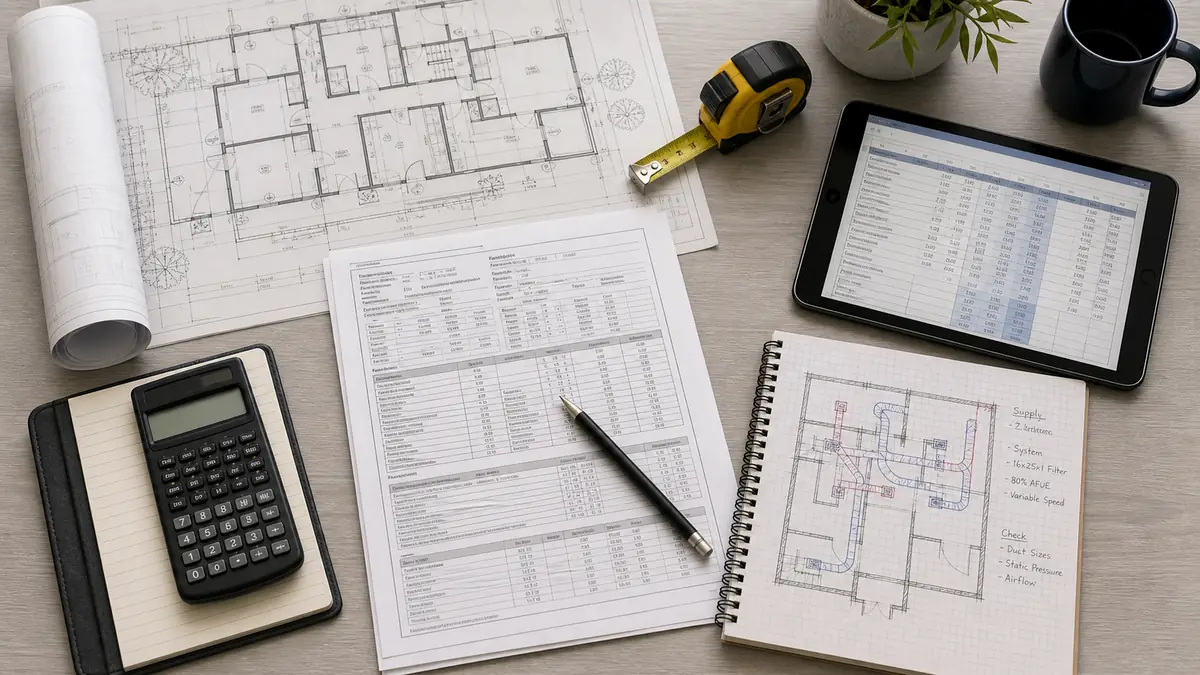
Manual J is the residential load-calculation standard published by ACCA, and any contractor worth hiring should be willing to put one in front of you. Rather than eyeballing it from square footage, it tallies the real heat your home gains and loses: the glass area and the way it faces, how much insulation you have, how much air leaks, ceiling height, the home's vintage, and the design temperatures for our corner of the state. What comes out is a load in BTU/h, broken out room by room and for the whole house, and that figure points straight to the correct Mitsubishi size. On a ductless layout it also reports each zone's load, so a little bedroom draws a little head while the great room gets a bigger one.
| Input | Why it matters in Arcadia |
|---|---|
| Glass area and orientation | West/south foothill glass drives a big 5 p.m. solar peak |
| Insulation and construction era | 1950s ranch vs new rebuild differ enormously |
| Infiltration / air tightness | Tight rebuilds need far less capacity |
| Design temperatures | Zone 9 cooling design near 95 to 100 F |
| Room-by-room loads | Sets each zone head size on a ductless plan |
A worked example: rule of thumb vs Manual J
Numbers make this concrete. Take a 2,000 square foot rebuild in Upper Rancho with good windows, R-38 attic insulation, and tight air-sealing. The old one-ton-per-500-square-feet shortcut says 4 tons, or 48,000 BTU/h of cooling. A real Manual J on that same tight house, accounting for the modern envelope, commonly lands closer to 2.5 to 3 tons - roughly 30,000 to 36,000 BTU/h. That is a full ton and a half of equipment the shortcut would have you buy and pay to run, on a house that cannot use it.
Now flip to a 1955 Lower Rancho ranch of the same 2,000 square feet, leaky, single-pane in places, with under-insulated walls and an attic that bakes. Here the shortcut's 4 tons might be near the cooling load - but Manual J also exposes that the bigger problem is the leaky envelope and ducts, so the smarter spend is air-sealing and duct work first, then a right-sized 3 to 3.5 ton inverter system rather than brute-forcing 4 tons of compressor against the leaks. Two identical footprints, two different answers - which is the whole reason a single tonnage rule fails in Arcadia.
| Home | Rule-of-thumb says | Manual J typically lands | Why the gap |
|---|---|---|---|
| Tight Upper Rancho rebuild | 4 tons / 48,000 BTU/h | 2.5 - 3 tons / 30-36k BTU/h | Modern envelope, low infiltration |
| 1955 Lower Rancho ranch | 4 tons / 48,000 BTU/h | 3 - 3.5 tons after sealing | Fix leaks first, then size down |
What is the oversizing failure chain?
The damage from oversizing is quiet - it shows up as one small misery after another rather than a single loud failure. Because an oversized system reaches the thermostat setpoint so quickly, it only runs in brief bursts, and those brief bursts are what short-cycling means. Short runtimes mean the indoor coil never stays cold long enough to wring humidity out of the air, so the house feels clammy even at 74 F. The frequent starts are the hardest moment on a compressor and inverter, so the equipment wears faster. Air does not circulate long enough to even out, so the back bedrooms lag while the thermostat hallway reads satisfied. And the bigger condenser cost more up front and draws a heavier startup surge. On a ductless inverter the symptom is milder because the head modulates down, but every head still has a minimum output it cannot go below, and an oversized head bounces off that floor and short-cycles just the same. The cure is never margin - it is the correct number from a load calculation.
How does foothill solar load change the answer?
This is the Arcadia-specific part most generic calculators miss. A home in Highland Oaks or upper Santa Anita Oaks with large west- and south-facing windows takes a punishing solar load in late afternoon, exactly when a Santa Ana event drives the foothills past 100 F. Two homes of identical square footage - one shaded and north-facing, one sun-loaded on a slope - can have very different peak loads and need different equipment. Manual J captures the orientation and glass, so we size for your 5 p.m. peak rather than a city average. Skip that and the sun-loaded rooms never catch up no matter how big the condenser.
How do load numbers map to Mitsubishi equipment?
Once we have the load, the equipment follows. A single sun-loaded room maps to a single MSZ head and MUZ condenser. A whole house maps to either a multi-zone MXZ-SM with heads sized per room or a ducted SVZ/MVZ air handler. The table below is a rough orientation only - your actual Manual J governs.
| Calculated load | Typical Mitsubishi path | Install cost lane (2026 SoCal) |
|---|---|---|
| Single room / addition | One MSZ head + MUZ condenser | $3,500 - $8,000 |
| Multi-room ductless | MXZ-SM SMART MULTI + sized heads | $9,000 - $20,000 |
| Whole-home ducted | SVZ/MVZ air handler + inverter | $6,000 - $16,000 |
| Full electrification | H2i Hyper-Heat sized for heat + cool | $6,000 - $16,000+ |
Read more on each path on our heat pump installation, ducted air handler, and Hyper-Heat pages.
What does Title-24 require once the system is sized?
Sizing is only the opening move; from there, California Title-24, Part 6 sets the rules. Here in Climate Zone 9, putting in a new or replacement split system calls for refrigerant-charge and airflow verification, and touching the ducts at all brings on HERS field-verified duct sealing signed off by an independent rater. The code keeps leaning toward heat-pump-ready and heat-pump-preferred baselines too, which tilts the field toward a Mitsubishi install. Before you lean on any compliance claim, double-check the precise SEER2 and HSPF2 minimums and which code cycle applies - the 2022 version or the 2025 update - for your particular equipment class. Our SEER2 and rebates guide takes up the efficiency side.
What happens if the system is sized wrong?
Too small, and it never quite catches setpoint on the cruelest foothill afternoons, grinding away nonstop and lifting your summer bill. Too large, and it short-cycles, leaves humidity hanging, and breeds the hot-room-cold-room calls we answer all the time. A single honest load calculation at the start heads off both. When a contractor names a tonnage straight off your square footage without ever asking about your glass or running a Manual J, take that as your cue for a second opinion - and a rightly sized Mitsubishi system, kept up on our maintenance calendar routine, will reward you with a longer life as well.
The bottom line on sizing an Arcadia system
- Insist on a Manual J load calculation; refuse a tonnage named off square footage alone.
- Expect a tight rebuild to need less capacity than the old rule suggests - often a ton or more less.
- On a leaky old ranch, seal the envelope and ducts first, then size down.
- Make sure west and south glass and orientation are in the calculation - that is the foothill peak.
- Match each ductless zone's head to its own room load; do not pad for margin.
- Confirm the install includes Title-24 charge and airflow verification, and HERS if ducts are touched.
Common questions about HVAC sizing
Is the one-ton-per-500-square-feet rule wrong?
For a present-day Arcadia home it usually is, because it hands you too much equipment. The shortcut was calibrated for drafty, thinly insulated old houses, and a well-sealed rebuild with quality glass and insulation often calls for a good deal less. Go too large and the home pays for it with short-cycling, swinging humidity, and rooms that never even out. A Manual J load calculation sets the rule of thumb aside and uses the actual numbers your house produces.
What information does a Manual J need from my home?
It draws on room-by-room floor area, ceiling heights, the kind and size of your windows and the way each one faces, how well the house is insulated, when it was built, how much air it leaks, and how the home sits on its lot. On an Arcadia foothill home, the west and south glass along with the sun it catches are some of the heaviest inputs. We collect all of it during a site visit, or read it off your plans when it is a rebuild.
Can a mini-split be too big?
It certainly can. An oversized inverter head does still modulate, yet there is a floor it cannot drop below, and once it hits that floor it starts short-cycling, leaving humidity behind and tiring the compressor. The entire point of going ductless is sizing each zone correctly, so we fit the head to that room's load rather than padding it with margin nobody needs.
Why does sizing matter more in Arcadia's foothills?
It comes down to the late-day sun. A foothill house with a wall of west glass peaks at a wholly different hour than a shaded flatland home of the same footprint. Manual J accounts for that, sizing the system to the 5 p.m. Santa Ana peak instead of some bland average. Miss it, and the back rooms keep falling behind.
How long does a Manual J take, and do I need plans?
For an existing Arcadia home it is a site visit of an hour or two to measure rooms, windows, insulation, and orientation, then the calculation itself. For a rebuild we work straight off your architectural plans and the window schedule, which is faster and lets us size before the framing is even up. Either way you get a written load in BTU/h, room by room, that the equipment selection has to match.
Should I size for the hottest possible day or an average?
Manual J sizes to a design temperature, not the single worst Santa Ana spike or a bland annual average. For Zone 9 that design point sits near 95 to 100 F. Sizing to the absolute extreme would oversize the system for all but a handful of hours and bring on the short-cycling problems; an inverter's modulation plus the design-day method covers the rare 105 F afternoon without penalizing the other 360 days.